

An AI agent is not a chatbot with a fancier name. It is an autonomous program capable of planning a sequence of actions, using external tools and adapting to intermediate results in order to reach a defined objective. A chatbot answers a question. An agent solves a problem.
The distinction may seem subtle. In practice, it changes the very nature of what AI can accomplish within a business. Gartner estimates that by 2028, 33% of enterprise software applications will incorporate AI agents, compared to less than 1% in 2024 (Gartner, 2024).
What an AI agent actually is
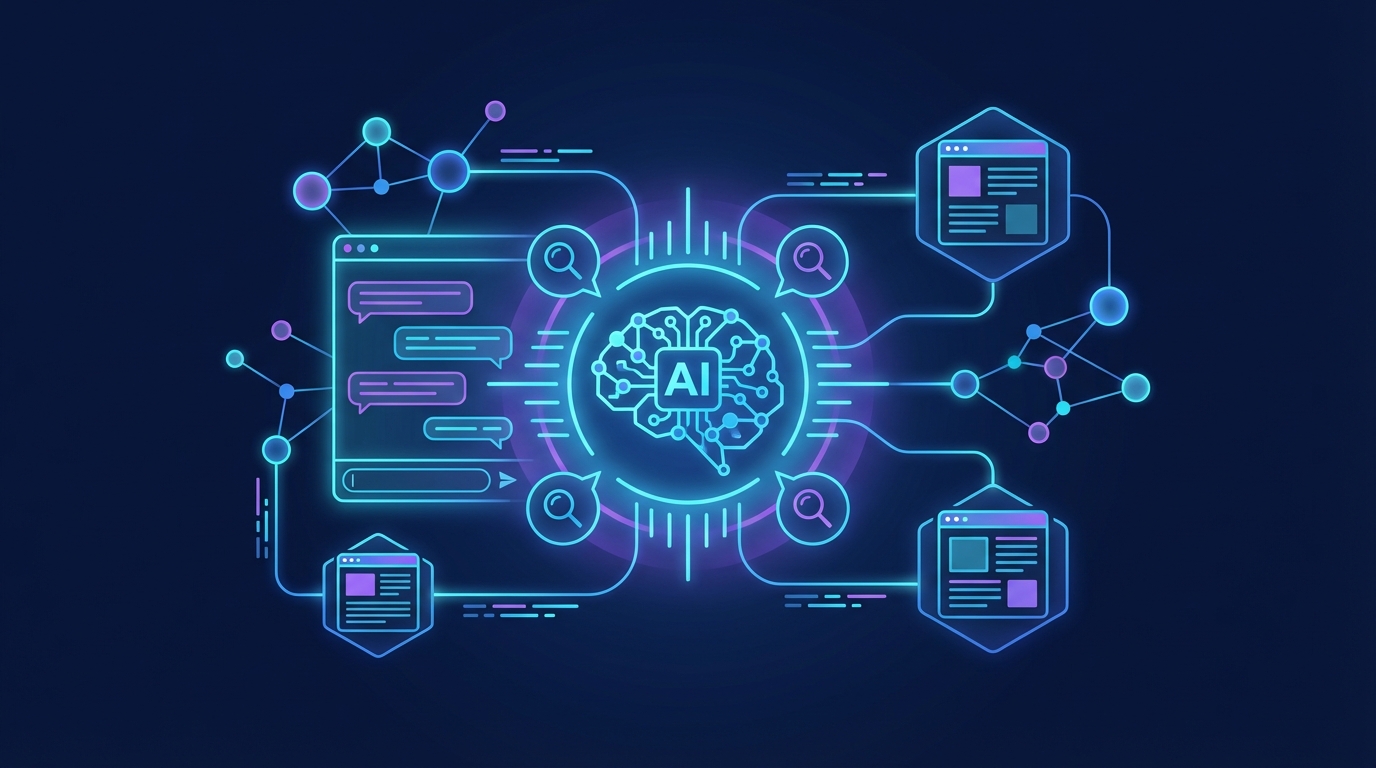
An AI agent is a software system that combines a language model (LLM) with three additional capabilities: perceiving its environment, reasoning about which actions to take and autonomously executing those actions through tools.
The term "agent" comes from AI research, where it describes any entity that perceives its environment and acts to maximise an objective. Current AI agents apply this principle using LLMs as their reasoning engine.
The four components of an AI agent:
- The LLM (brain): Claude, GPT-4, Gemini or an open-source model. It understands instructions, reasons about context and decides on next actions.
- Tools (hands): APIs, databases, web browsers, file systems. The agent uses these tools to act on the outside world.
- Memory (context): action history, previous results, persistent instructions. Allows the agent to maintain coherence across multiple steps.
- The action loop (method): a cycle of perception, reasoning, action and observation that repeats until the objective is reached.
This cycle has a technical name: the ReAct loop (Reasoning + Acting), a framework described by researchers at Princeton and Google in 2022. The agent reasons about what needs doing, acts, observes the result and adjusts its plan.
Chatbot, AI assistant, AI agent: the practical differences
Confusion between these terms is understandable. Vendors themselves blur the boundaries. Here is an operational distinction framework.
| Criterion | Traditional chatbot | AI assistant (Claude, ChatGPT) | AI agent |
|---|---|---|---|
| Interaction | Question-answer | Rich conversation | Goal to achieve |
| Autonomy | None (scripted) | Low (responds, does not act) | High (plans and executes) |
| External tools | No | Limited (plugins, web) | Yes (APIs, files, databases, actions) |
| Memory | Session only | Session + limited history | Long context + persistent memory |
| Error handling | Fails silently | Reports the error | Retries with an alternative strategy |
| Typical use case | Website FAQ | Writing, analysis | Lead qualification, workflow automation |
A concrete example illustrates the difference. Ask a chatbot: "What is the status of order 4582?" It checks its database and responds. Ask an AI assistant: "Write a follow-up email for order 4582." It drafts the email. Ask an AI agent: "Handle the follow-up for order 4582." It checks the status in the CRM, identifies a delivery delay, drafts an apology email to the customer, updates the support ticket and notifies the logistics manager.
How an AI agent works: technical architecture
Without going into code, understanding an agent's architecture helps evaluate what it can accomplish for your business.
Step 1: Receiving the objective. The agent receives a high-level instruction. Not a question, but a mission. "Qualify incoming leads and schedule a meeting with hot prospects."
Step 2: Decomposition. The LLM analyses the objective and breaks it into sub-tasks. Read new form submissions. Enrich company data. Calculate a score. Send an email. Propose a calendar slot.
Step 3: Sequential execution. The agent executes each sub-task using available tools. It calls the CRM API to read forms, queries a scoring database, uses the Gmail API to send an email and checks Google Calendar for an available slot.
Step 4: Observation and adaptation. After each action, the agent observes the result. If the CRM API returns an error, it retries after a delay. If the lead already has a scheduled meeting, it moves to the next one. This adaptive capacity distinguishes an agent from a standard automation script.
Step 5: Reporting. The agent summarises what it has accomplished and communicates it to the human supervisor.
AI agent frameworks in 2025
Several tools allow building AI agents, from no-code to advanced development.
| Framework | Technical level | Strengths | Limitations |
|---|---|---|---|
| n8n (AI Agent node) | Intermediate | Visual, self-hostable, 400+ integrations | Linear agents, no multi-agent support |
| LangChain / LangGraph | Developer | Flexible, multi-agent, active community | Steep learning curve, complex abstractions |
| Claude Code (Anthropic) | Developer | Natively agentic, terminal-based, MCP | Development-focused, not marketing |
| CrewAI | Developer | Multi-agent specialists, defined roles | Python required, uneven documentation |
| Voiceflow / Botpress | Low to medium | Visual interface, chatbot deployment | Simple agents, no advanced orchestration |
| Make / Zapier | Low | No-code, fast to deploy | No reasoning, linear automation |
The distinction between automation and agency matters. Make and Zapier automate predefined workflows (if A, then B). An AI agent reasons and adapts its behaviour. The two approaches complement each other. Automation tools handle repetitive, predictable flows. Agents handle situations requiring judgement.
AI agent use cases for SMEs
AI agents are not reserved for large enterprises. Several use cases are accessible to SMEs today.
Lead qualification and routing. An agent monitors incoming forms, enriches the data, assigns a score and routes the lead to the right salesperson. Response time drops from hours to minutes.
Level 1 customer support. The agent handles recurring requests (order status, FAQ, appointment booking) and escalates complex cases to a human with a contextual summary. An AI chatbot built on this logic resolves 40 to 60% of requests without human intervention.
Automated competitive monitoring. The agent monitors competitor websites and social media, detects price changes, new products and marketing campaigns. It produces a weekly report highlighting items worth attention.
Advertising campaign management. The agent analyses Google Ads performance in real time, identifies underperforming campaigns, adjusts bids and generates alerts. Monitoring shifts from manual to continuous.
Content creation and distribution. The agent produces content variants for each platform (LinkedIn, newsletter, blog), schedules publication and measures engagement. Distribution time per piece of content drops from 45 minutes to zero after the initial approval.
Current limitations of AI agents
AI agents are progressing rapidly, but several limitations persist in 2025.
Reliability remains the primary weakness. An agent chaining 10 actions has an end-to-end success rate lower than a deterministic script. Each step introduces a risk of error linked to the LLM's reasoning. For critical processes (invoicing, sensitive data), human oversight remains essential.
Cost per execution varies by model. An agent using Claude Opus for reasoning at each step costs significantly more than a Make workflow. For high-volume tasks (1,000+ executions per day), model optimisation (Haiku for simple steps, Sonnet for reasoning) becomes necessary.
Data security raises specific questions. An agent accessing your CRM, email and calendar holds broad permissions. Granular access control and action logging are essential, particularly within a GDPR context.
Latency is a constraint for real-time interactions. An agent reasoning through 5 steps before responding takes 10 to 30 seconds. Acceptable for background processing, problematic for a live conversation.
Where to start with AI agents
Adopting AI agents in an SME follows a progressive path.
Begin by identifying a repetitive task that occupies a skilled team member on mechanical work. Lead qualification, reporting, competitive monitoring and level 1 support are frequent candidates.
Test first with a standard automation workflow (n8n, Make). If the flow is linear and predictable, automation suffices. If the task requires complex conditional decisions, reformulation or contextual adaptation, an AI agent adds genuine value.
An AI strategy consultant can audit your processes, identify high-ROI use cases and design the right architecture. The initial investment pays back when the agent handles sufficient volume to offset development and execution costs.
Exploring the dedicated AI agent service page provides more detail on implementation approaches tailored to SME contexts.
Frequently asked questions
Can an AI agent work without human supervision?
Technically yes, but this is not recommended for high-stakes processes. The common practice is "human-in-the-loop" mode: the agent handles routine actions autonomously and requests human approval for critical decisions (sending a client email, modifying a budget, deleting data).
What is the difference between an AI agent and an n8n or Make workflow?
An n8n or Make workflow follows a predefined path: if A, then B, otherwise C. An AI agent reasons about the situation and chooses its actions. Workflows are more reliable and less expensive for simple flows. Agents add value when the task requires judgement or adaptation to unforeseen situations.
How much does an AI agent cost for an SME?
Cost depends on the model and volume. A lead qualification agent using Claude Sonnet, processing 50 leads per day, costs approximately EUR 30 to 60 per month in API fees. Initial development (architecture, integration, testing) requires 2 to 5 days of technical work. ROI is calculated in human time saved on the automated task.
Are AI agents GDPR-compliant?
Compliance depends on implementation. Data processed via the Claude or GPT API is not used for training (a contractual guarantee). Storage, retention and access rights must be configured according to GDPR requirements. For cross-border businesses, Swiss FADP compliance adds specific constraints that a consent management specialist can address.