
A contractor spends an average of 45 minutes per day answering the phone and processing quote requests, according to a 2024 UK Federation of Master Builders survey. On a job site, these interruptions cost time, focus, and sometimes clients: a prospect who does not get a response within the hour turns to a competitor in 60% of cases (Google/Ipsos, 2023).
An AI chatbot addresses this problem directly. A conversational assistant installed on your website greets every visitor, asks the relevant questions, qualifies the enquiry, and provides a price estimate. All without you picking up the phone. Here is how it works in practice, what it costs, and what you can realistically expect.
What an AI Chatbot Is (and What It Is Not)
An AI chatbot is a program integrated into your website that converses with visitors in natural language. Unlike older chatbots that offered multiple-choice buttons ("Plumbing issue" / "Electrical issue"), AI-powered chatbots understand free-form text. A visitor can type "I have a leak under my kitchen sink since this morning, do you cover the Annecy area?" and receive a tailored response.
It is not a robot that replaces the tradesperson. The chatbot does not produce a detailed quote with precise measurements and unit prices. It collects essential information (type of work, location, urgency, contact details), provides an indicative price range, and sends a qualified brief to the tradesperson. The expertise, accurate pricing, and client relationship remain human.
This distinction matters: the chatbot is an intelligent filter, not an autonomous salesperson. It separates serious enquiries from casual browsers, structures the information, and speeds up your response time. The prospect perceives a reactive, organised business. You receive an actionable file instead of a vague message.
Why Tradespeople Lose Clients Without Knowing It
The journey of a prospect looking for a tradesperson follows a predictable pattern. They type "plumber near me" or "emergency electrician" into Google. They click on two or three results. They send a message or call. If they do not get a fast response, they move on.
The structural problem for tradespeople lies in availability. Between 8 am and 6 pm, you are on the job. Answering the phone interrupts your work. Not answering drives the prospect away. Standard contact forms generate responses in the evening, sometimes the next day. Too late: the prospect has already found someone else.
A plumber investing in digital visibility through SEO or Google advertising attracts traffic to the site. But that traffic only converts to revenue if the response is immediate. The chatbot fills this gap in the conversion funnel (the sequence that turns a visitor into a client).
The data confirms this reality. According to HubSpot (2024), businesses that respond to an inbound enquiry within five minutes have a lead qualification rate 21 times higher than those that respond in 30 minutes. For a tradesperson, this means a chatbot active at 2 pm on a Tuesday converts enquiries that an evening callback will never recover.
How a Quote Chatbot for Tradespeople Works
The technical setup is simpler than you might think. Three components are enough.
The conversational engine. This is the chatbot's brain. It uses a language model (such as those from OpenAI or Anthropic) configured with your trade-specific data: types of work offered, geographic coverage, indicative pricing grid, typical lead times. When a visitor asks a question, the engine generates a response consistent with your business.
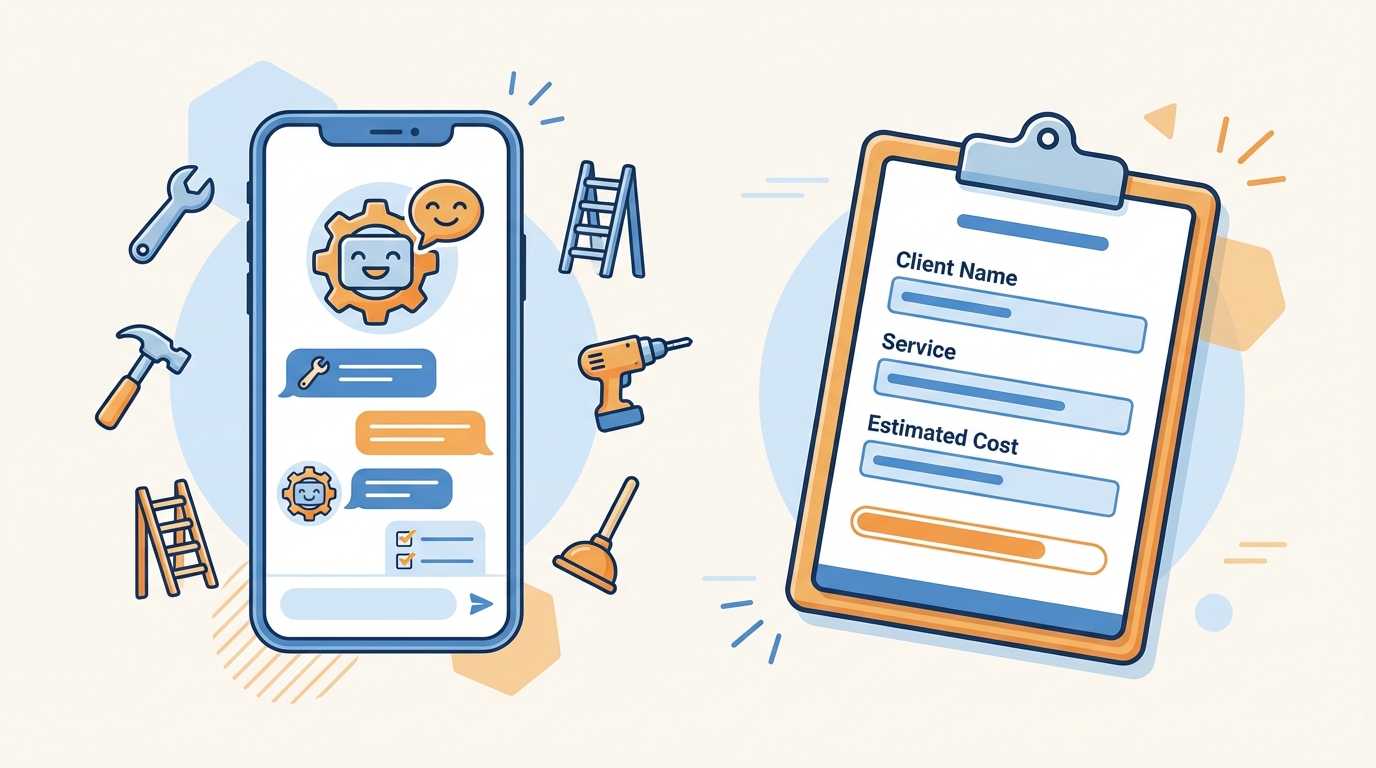
The qualification scenario. The chatbot follows a logical sequence to collect useful information:
- Nature of the work (repair, installation, renovation)
- Precise location (town, area if relevant)
- Urgency level (immediate, within 48 hours, schedulable)
- Description of the problem or need
- Contact details (phone, email)
- Availability windows
Each visitor response populates a structured form that you receive via email, SMS, or a CRM notification.
The price estimate. Based on the information collected, the chatbot can display a price range. For a boiler replacement, for example: "Based on your description, the cost typically falls between 800 and 1,400 euros, installation included. A precise quote requires an on-site visit." This transparency reassures the prospect and filters out those whose budget is incompatible.
Deployment: From Tool Selection to Going Live
Deploying an AI chatbot on a tradesperson's website takes one to three weeks depending on the complexity required. Here are the key steps.
Platform choice depends on your needs and budget. Botpress offers a free tier suitable for small volumes (up to 1,000 conversations per month). Voiceflow provides a visual interface for building scenarios without coding, starting from 50 euros per month. Custom solutions via the OpenAI API allow full personalisation but require a developer or a specialist AI chatbot provider.
The configuration phase is the core of the work. You need to write the standard responses, define the indicative pricing grid, set the conditions for handoff to a human (when the chatbot cannot answer, it offers a phone callback), and test scenarios with real cases.
Integration into a WordPress site is done via a widget (a small code block inserted into your site). Most platforms provide a snippet to copy and paste. The chatbot then appears at the bottom right of every page, ready to converse.
The run-in phase lasts two to four weeks. During this period, read every conversation to spot questions the chatbot answers poorly, wording that creates confusion, and missing information. Adjust responses and expand the knowledge base. A well-tuned chatbot after one month handles 85% of common enquiries correctly.
Concrete Results: What a Chatbot Changes for a Tradesperson
Field feedback paints a realistic picture of the benefits.
An electrician based near Geneva deployed a chatbot in September 2024. Before, his site generated around 15 contact forms per month, 40% of which were usable (the rest being too vague to act on). With the chatbot, the number of qualified enquiries rose to 25 per month. The chatbot eliminated out-of-area requests, clarified needs, and systematically collected contact details. The conversion rate from enquiry to completed job went from 20% to 35%.
The daily time savings are the most immediate benefit. No more evening callbacks to qualify vague requests. Each file arrives with the information needed to decide in two minutes whether the job merits a site visit. Tradespeople surveyed estimate saving between 30 and 60 minutes per day.
Round-the-clock availability captures enquiries that would otherwise be lost. Google searches for tradespeople peak between 8 pm and 10 pm, when homeowners return and notice a problem. A chatbot active at those hours recovers prospects that neither the phone nor a standard contact form would catch.
Professional perception improves too. A prospect who interacts with a smooth, precise chatbot sees a well-organised business. This impression is particularly valuable in the trades, where trust is a decisive factor in choosing a contractor.
Costs and Return on Investment
The cost question deserves precise figures. Here is a realistic breakdown for a sole trader or small business with fewer than ten employees.
Setup cost ranges from 500 to 2,000 euros if you hire a specialist for the initial configuration (scenario writing, integration, testing). Some tech-savvy tradespeople handle this step themselves with a no-code platform, reducing the investment to the monthly subscription alone.
Monthly running costs range from 0 to 100 euros depending on the platform and conversation volume. For a tradesperson receiving 50 to 200 conversations per month, a budget of 30 to 50 euros per month covers requirements comfortably.
The ROI calculation is straightforward. If the chatbot generates three additional jobs per month (through better qualification and faster response), with an average ticket of 500 euros and a 40% margin, the monthly gain is 600 euros. Deduct 50 euros for the subscription: the ROI is positive from month one.
The financial risk is therefore low. Even in a pessimistic scenario where the chatbot generates only one additional job per month, the investment remains profitable. And the time freed up (fewer interruptions on site) has an indirect value that is hard to quantify but real.
Common Mistakes to Avoid During Deployment
Several pitfalls await tradespeople who launch without a method.
The first is wanting the chatbot to answer everything. A high-performing chatbot covers 80% of common enquiries and hands over the remaining 20% to a human. Pursuing exhaustiveness delays launch and produces approximate answers that frustrate visitors.
The second pitfall concerns pricing. Displaying overly precise prices invites disputes. Displaying ranges that are too wide loses credibility. The recommended wording is a range with an explicit mention of on-site assessment: "Indicative estimate between X and Y euros. The exact amount will be confirmed after an on-site inspection."
Neglecting updates is the third risk. Your rates change, your service area shifts, you add or remove offerings. The chatbot must reflect these changes. Plan a quarterly review of its responses.
The fourth pitfall is not tracking conversations. Regularly reading exchanges between the chatbot and your visitors reveals recurring unanswered questions, confusing wording, and improvement opportunities. This review takes 15 minutes per week and progressively increases the chatbot's accuracy.
Frequently Asked Questions
Does an AI chatbot work for all trades?
Yes, provided the qualification scenario is adapted to the trade. A plumber, electrician, locksmith, and painter do not have the same qualification questions. The type of work, urgency criteria, and pricing grid differ. The chatbot structure stays the same; only the content changes.
Will my customers accept talking to a robot?
Data suggests they will. According to Drift (2024), 62% of consumers prefer using a chatbot rather than waiting for a human adviser, especially for simple requests like a price estimate. The chatbot should, however, be transparent about its nature and offer human contact at any time.
How long does it take to install a chatbot on my site?
With a no-code platform such as Botpress or Voiceflow, allow two to five effective working days for a functional chatbot. This includes writing scenarios, testing, and site integration. A specialist provider shortens this to one or two days on your end, with the rest handled externally.
Does the chatbot replace my phone number?
No, and it should not. The chatbot is a complementary channel. Some clients prefer calling; others prefer writing. The chatbot captures the second group and filters enquiries for both. Keep your phone number visible on every page of your site.
What happens if the chatbot gives a wrong price estimate?
This is exactly why every estimate must be presented as indicative, with an explicit mention of confirmation after on-site assessment. This precaution protects the tradesperson legally and commercially. The visitor understands that the final price depends on factors that only a site visit can evaluate.