

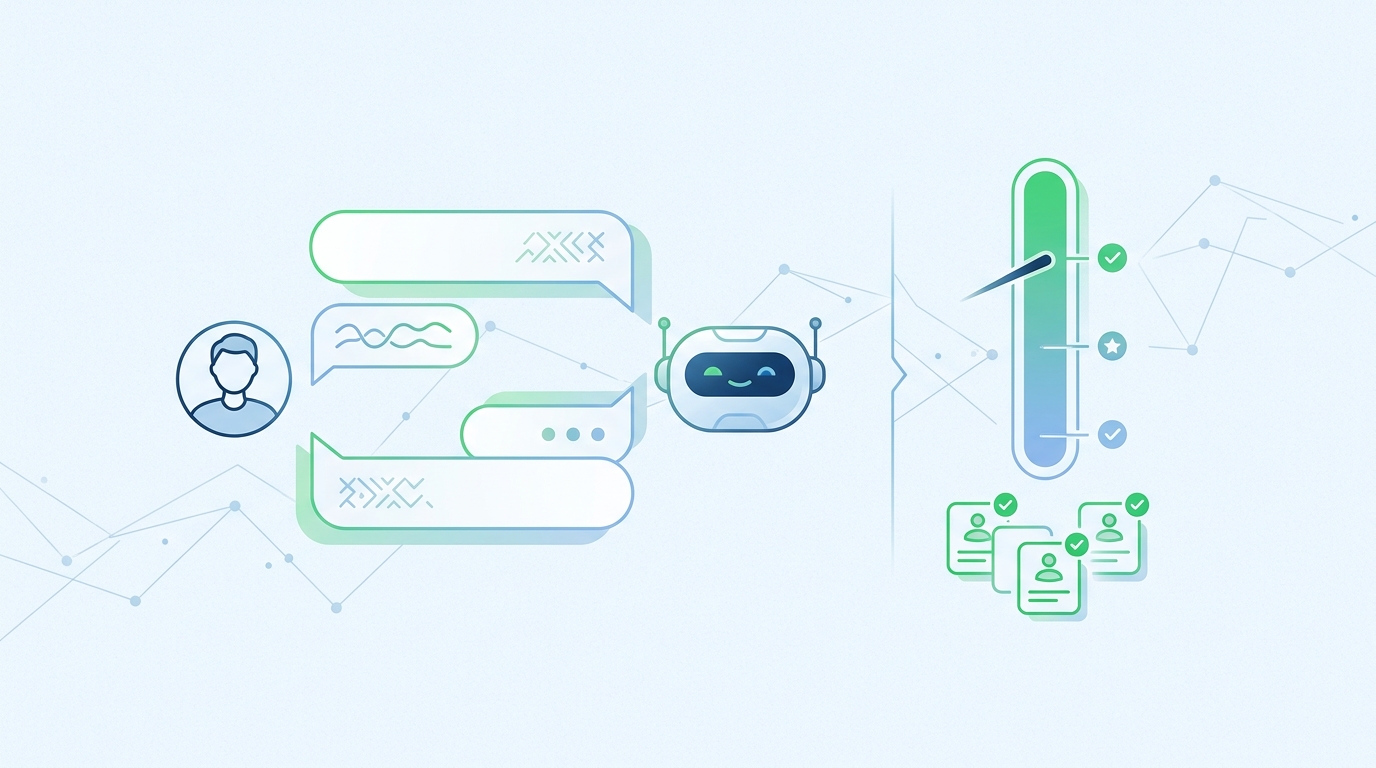
A prospect fills out your contact form at 10:43 PM. Your sales rep calls them back the next morning at 10 AM. By then, the prospect has already contacted two competitors and signed with the first one who responded. This scenario plays out in every SMB that relies on web forms to generate leads.
The data is well established: businesses that respond within 5 minutes are 21 times more likely to qualify a lead than those who respond after 30 minutes (source: Lead Response Management Study, InsideSales). The problem is not willingness to respond quickly. It is human availability.
An AI qualification agent closes that gap. It receives the lead, enriches it, qualifies it, routes it, and can even initiate the first conversation. Around the clock, in minutes.
The Problem: Manual Qualification, Inconsistent Results
The typical qualification process in a service-oriented SMB follows a repetitive pattern.
- The form submission arrives in an email inbox
- A sales rep opens it (anywhere from 1 to 24 hours later)
- They manually check whether the company exists, its size, its industry
- They subjectively evaluate the lead quality
- They decide to call back, send an email, or do nothing
- They update (or forget to update) the CRM
This process stacks four flaws. Response time is too long. Qualification is subjective and inconsistent from one rep to another. The CRM gets incomplete entries. Low-priority leads are ignored when some of them could have converted with appropriate nurturing.
Average time a sales rep spends on qualification:
| Step | Time (minutes) | Human Value-Add |
|---|---|---|
| Read the form | 2 | Low |
| Research the company | 5-10 | Low (automatable) |
| Assess potential | 3 | Medium |
| Draft a reply email | 5-10 | Medium |
| Update the CRM | 3-5 | None |
| Total per lead | 18-30 | - |
On 20 leads per week, that is 6 to 10 hours of sales work. An AI agent reduces this to a 2-minute validation per qualified lead.
Full Architecture of the Qualification Agent
The qualification agent is built around five connected modules. Each module can be replaced or modified without breaking the others.
Module 1: Multi-Channel Collection
The agent monitors lead sources continuously.
- WordPress form: webhook triggered on each submission (Contact Form 7, Gravity Forms, WPForms)
- Inbound email: the agent parses emails received at the contact address via the Gmail API
- Live chat: the AI chatbot on the site transfers qualifying conversations to the agent
- LinkedIn: detection of incoming messages via the LinkedIn API (requires LinkedIn Sales Navigator)
Each source feeds a normalized format: name, email, phone, company, message, source, date.
Module 2: Data Enrichment
The form does not tell the full story. The agent fills in the gaps through specialized APIs.
Enrichment sources:
| Data | Source | Approximate Cost |
|---|---|---|
| Company size, industry, revenue | ZoomInfo, Clearbit, Apollo | $0.05-0.15 / query |
| LinkedIn profile of the contact | Proxycurl, PhantomBuster | $0.01-0.05 / query |
| Website technology stack | BuiltWith, Wappalyzer | Free (basic) |
| Domain history (age, traffic) | SEMrush API, SimilarWeb | Variable |
| Business registration data | Company registries, APIs | Free or low cost |
Enrichment transforms a 4-field form into a 15-to-20-data-point prospect profile. The sales rep receives a complete dossier instead of a name and a message.
Module 3: Intelligent Scoring
Traditional scoring assigns points based on static rules. The AI agent adds an interpretation layer that reads the message and evaluates context.
Hybrid scoring grid (rules + AI):
| Criterion | Points | Source |
|---|---|---|
| Stated budget > $5,000 | +30 | Form |
| Stated budget $2,000-$5,000 | +20 | Form |
| Stated budget < $2,000 | +5 | Form |
| Company > 10 employees | +15 | Enrichment |
| Priority industry (e-commerce, healthcare, construction) | +20 | Enrichment |
| Urgent request (detected in message) | +20 | AI analysis |
| Specific request (service identified) | +15 | AI analysis |
| Vague request ("just looking for info") | -10 | AI analysis |
| Existing client or contact | +25 | CRM |
| Existing website with traffic | +10 | Enrichment |
The "AI analysis" component is the agent's value-add over a standard Make or n8n workflow. The LLM reads the prospect's message and extracts qualitative signals that static rules miss.
A message stating "We are launching a new e-commerce site and need an acquisition partner starting next month" contains three strong signals: a concrete project, an identified need, and a short timeline. The agent detects them and adjusts the score.
Module 4: Routing and First Response
Based on the score, the agent triggers a different workflow.
Score 70+ (Hot lead):
- Immediate contact creation in the CRM (HubSpot, Pipedrive) with all enriched data
- Slack notification to the assigned sales rep with summary and approach recommendation
- Personalized reply email to the prospect (AI-drafted, sent within 2-3 minutes)
- Calendar booking link via Calendly or Cal.com
Score 40-69 (Warm lead):
- Contact creation in the CRM, pipeline "To qualify"
- Reply email with educational content tailored to the expressed need
- Entry into a nurturing sequence (3 emails over 10 days)
- Automated follow-up if no open after 5 days
Score below 40 (Cold lead):
- Contact creation in the CRM, pipeline "Long-term nurturing"
- Thank-you email with a free resource (guide, checklist)
- Entry into the monthly newsletter
- No notification to the sales rep (no wasted time)
Module 5: Learning and Optimization
The agent improves by tracking the outcomes of its qualifications.
Each month, the agent compares its qualification scores against actual results: did the lead scored 85 convert? Should the lead scored 35 have been treated as a priority? This feedback allows the scoring weights to be adjusted.
This feedback loop distinguishes an intelligent agent from a static script. After 3 months of operation, scoring accuracy typically improves by 15 to 25% compared to the initial rules.
Concrete Case: Qualification Agent for a Service Business
Take a realistic scenario. A plumbing company receives 30 to 50 inquiries per week through its WordPress site. Without an agent, the owner spends 90 minutes per day sorting requests, calling prospects, and updating the schedule.
Agent configuration:
- Form: 5 fields (name, phone, email, type of service, problem description)
- Enrichment: zip code verification (service area), urgency detection in the message
- Simplified scoring: urgency (leak, breakdown) +40, confirmed service area +20, complete contact info +15, detailed description +10
Scoring outcomes:
| Request Type | Score | Agent Action |
|---|---|---|
| "Leak under the kitchen sink, urgent" + local zip | 85 | SMS to the plumber + auto-email to client with estimated response time |
| "Quote for bathroom renovation" + nearby zip | 45 | Email with portfolio + Calendly booking link |
| "Price for drain cleaning" + out-of-area zip | 15 | Polite decline email + suggestion of a local professional |
Results measured after 2 months:
- Average response time: from 4 hours to 3 minutes
- Lead-to-job conversion rate: from 22% to 38%
- Daily admin time: from 90 minutes to 15 minutes
- Out-of-area leads processed unnecessarily: from 8 per week to zero
According to Harvard Business Review research, 35 to 50% of B2B sales go to the vendor that responds first. Speed alone moved the needle significantly in this case.
The plumber's WordPress site integrates the form connected to the agent. The entire system runs without daily technical intervention.
Technical Stack and Costs
Minimal stack for a first qualification agent:
| Component | Tool | Monthly Cost |
|---|---|---|
| Orchestrator | n8n Cloud | $20 |
| LLM (scoring + email) | Claude Sonnet API | $20-40 |
| LLM (simple tasks) | Claude Haiku API | $5-10 |
| Data enrichment | Clearbit / Apollo | $30 |
| CRM | HubSpot Free | $0 |
| Calendar | Cal.com Free | $0 |
| Gmail / existing SMTP | $0 | |
| Total | $75-100/month |
That budget compares to the cost of a part-time sales assistant ($1,500+/month) or the time the owner loses on sorting tasks (valued at $50-100/hour).
Advanced stack (multi-channel, multi-agent):
- Add Proxycurl for LinkedIn enrichment (+$30)
- Switch to self-hosted n8n to eliminate hosting cost
- Integrate a Voiceflow chatbot connected to the same agent (+$50)
- Add a Whisper transcription module for phone calls (+$20)
- Total: $120-200/month for a comprehensive solution
Common Mistakes to Avoid
Mistake 1: Scoring without enriching. A 3-field form does not contain enough information to qualify a lead properly. Enrichment is the step that transforms partial data into an actionable profile.
Mistake 2: Automating email sending without initial oversight. For the first months, have a human validate each outgoing email. The LLM can produce an off-base response on an edge case. After 200-300 validated emails, the error rate becomes acceptable for partial autonomy.
Mistake 3: Ignoring cold leads. A lead scored 25 today can become a score-80 lead in six months. Automated nurturing (newsletter, educational content) maintains contact with zero ongoing effort. Multiple studies confirm that 35 to 50% of B2B deals go to the first responder (source: Harvard Business Review).
Mistake 4: Over-complicating the scoring. A grid with 30 criteria is not more accurate than a grid with 10 well-chosen criteria. Start simple. Adjust after 3 months of data.
Mistake 5: Forgetting compliance. The collected and enriched data falls under GDPR (and potentially other regional regulations like CCPA or Switzerland's FADP). Legal basis (legitimate interest or consent), retention period, access and deletion rights: these elements must be designed into the agent from day one.
Measuring the Agent's ROI
The ROI of a qualification agent is measured across three axes.
Axis 1: Time saved. Multiply the monthly lead count by the average manual qualification time. For 100 leads/month at 20 minutes each, the savings total 33 hours/month. Valued at the sales rep's hourly rate ($30-50/hour), that represents $1,000-1,650/month.
Axis 2: Conversion rate. Reducing response time from hours to minutes mechanically lifts the conversion rate. A 5-point improvement (from 20% to 25%) on 100 leads/month yields 5 additional clients. With an average deal value of $500, that is $2,500/month in additional revenue.
Axis 3: CRM data quality. A CRM systematically fed with enriched data improves sales management. Reports become reliable. Sales forecasts get sharper. The value is harder to quantify but tangible.
For an SMB with 50-100 monthly leads, the ROI of a qualification agent reaches a 10x to 20x multiple relative to its operating cost. Implementation by an AI strategy consultant accelerates deployment and prevents architectural mistakes.
Frequently Asked Questions
Can the agent handle leads in multiple languages?
Yes. Current LLMs (Claude, GPT-4) comprehend and draft in dozens of languages. The agent detects the language of the incoming message automatically and responds in kind. For businesses serving international markets, this multilingual capability is a practical advantage.
What happens if the agent mis-scores a lead?
A mis-scored lead gets processed in the wrong pipeline (a hot lead treated as cold, or vice versa). The primary risk is neglecting a good lead. Guardrails: weekly manual review of rejected leads, notification for any lead with a long message (a signal of high engagement), and monthly scoring grid adjustments.
Do I need a developer to deploy this agent?
The basic version (form to enrichment to scoring to CRM to email) can be built in n8n or Make without writing code. The n8n AI Agent node or the HTTP module calling the Claude API handles the reasoning. An intermediate technical profile is sufficient. For advanced multi-channel orchestration, a Python developer or specialized consultant is recommended.
Can the agent connect to any CRM?
Most modern CRMs offer a REST API: HubSpot, Pipedrive, Salesforce, Zoho, Monday. The agent connects via HTTP calls or native n8n/Make modules. CRMs without an API (Excel spreadsheet, local software) require an intermediate bridge (Google Sheets or a database).