
Someone is looking for a tradesperson, a restaurant or a healthcare professional nearby. They open Google, type "plumber Annecy" or "osteopath Bonneville," and scan the first three results in the local pack (the box with the Google Maps snippet). According to Google (2024), 76% of people who perform a local search on their smartphone visit a business within 24 hours. And 28% of those searches lead to a purchase.
For a business operating in the French Alps, local SEO is not an optional marketing tactic. It is the most direct acquisition channel between a nearby prospect and your activity. The Haute-Savoie department has characteristics that make the process both strategic and technical: a high business density in cities like Annecy and Annemasse, a network of tradespeople and shops in semi-rural zones (the Arve Valley, the Chablais region), and proximity to the Swiss border, which creates bilingual search dynamics.
This guide covers the concrete levers of local SEO for businesses in the 74 department and the broader French Alps: Google Business Profile, NAP citations, customer reviews, geo-targeted content and local link building.
Google Business Profile: The Cornerstone of Local SEO
Google Business Profile (formerly Google My Business) is the free listing that appears in search results and on Google Maps when someone searches for a local business. This listing displays your name, address, phone number, opening hours, photos, customer reviews and a link to your website.
The completeness of your listing directly influences your position in the local pack. Google confirms this in its official documentation: complete profiles are 2.7 times more likely to be considered trustworthy by users. Filling out every available field is not optional.
Start with the fundamentals. Your business name must match your official registered name exactly (no artificially inserted keywords; Google penalises this practice). The address must be precise and consistent with what appears on your website and other online directories. The phone number should be a local line, not a personal mobile shared across multiple activities.
Categories deserve close attention. The primary category determines which searches trigger your listing. "Plumber" and "plumber heating engineer" do not target the same queries. Secondary categories broaden coverage. A physiotherapist in the Lake Geneva area would add "sports physiotherapist" and "rehabilitation" as secondary categories to capture specific searches.
Attributes (card payment, wheelchair accessibility, Wi-Fi, online booking) enrich the listing and respond to filters Google offers users. Photos influence click-through rates: according to BrightLocal (2024), listings with over 100 photos receive 520% more calls and 2,717% more direction requests than the median. Publish authentic photos of your premises, team and completed work. Skip stock images.
NAP Citations: The Consistency That Reassures Google
NAP stands for Name, Address, Phone. NAP citations refer to every mention of these three pieces of information across the web: online directories, Yellow Pages, Yelp, professional sites, chambers of commerce, municipal directories.
Google cross-references these sources to verify the legitimacy and location of your business. Inconsistent information (an old phone number on Yellow Pages, a different address on a professional directory) creates a confusion signal that degrades your local ranking.
Auditing your existing citations is the first step. Search your business name on Google, identify every mention and verify the consistency of information. Priority platforms for a business in the French Alps include: Pages Jaunes, Google Business Profile, Bing Places, Apple Maps, the Haute-Savoie CCI directory, departmental business listings, intercommunal websites (Grand Annecy, Annemasse Agglo, Faucigny-Glieres) and sector-specific professional directories.
For businesses near the Swiss border, Swiss directories count too. Local.ch, search.ch and canton-level directories in Geneva and Valais capture searches from Swiss prospects looking for a provider on the French side. This lever is underused by most SMEs in the Annemasse-Geneva cross-border area.
The rule is straightforward: everywhere your business is mentioned, the name, address and phone number must be strictly identical, character for character. "Rue" vs. "R." vs. "r." are not equivalent for an algorithm.
Customer Reviews: The Ranking Factor You Cannot Ignore
Google reviews are the third local ranking factor according to the Whitespark (2024) study, behind GBP listing relevance and geographic proximity. Review volume, average rating and review recency all influence both positioning and click-through rate.
A local business with 87 reviews and a 4.6 rating will almost always be clicked before a competitor with 12 reviews and a 4.8 rating. Volume sends a trust signal that the rating alone cannot compensate. For an SME in the French Alps, a realistic target is reaching 50 reviews in the first year and maintaining a steady flow of two to four new reviews per month.
The method for collecting reviews relies on a systematic process, not luck. After each service delivery, send an SMS or email containing a direct link to your Google listing's review section. This link can be generated from the GBP interface or via a URL shortener. The message should be brief and sent within 24 hours of the service, when satisfaction is still fresh.
Responding to every review (positive and negative) is a signal Google takes into account. A professional response to a negative review reassures prospects reading the exchange. It demonstrates that the business takes feedback seriously. Deleting or ignoring negative reviews is a mistake that costs more than the review itself.
Fake reviews are detected by Google with increasing accuracy. Buying reviews or exchanging them between businesses risks profile suspension. The risk is not worth taking.
Geo-Targeted Content: Going Beyond Just Mentioning a City Name
Adding "French Alps" or "Annecy" to your title tag does not constitute a local content strategy. Google expects content that demonstrates a real presence and genuine territorial expertise.
Creating pages for each service area works, provided each page delivers truly unique content. A "Plumber Annecy" page and a "Plumber Bonneville" page where only the city name changes will be treated as duplicate content. Each page must reflect local specifics: the economic fabric, area-specific problems, local client references, landmarks.
The French Alps offer rich angles for local content. The Arve Valley and its precision machining industry (the global capital of bar turning) create specific B2B demand. The Annecy basin concentrates service-sector SMEs and premium tourism. The Annemasse border zone requires dual compliance with GDPR and the Swiss Federal Data Protection Act (FADP). Mountain resorts like Chamonix, Megeve and Morzine have seasonality that shapes digital strategy. These specifics feed local content that national competitors simply cannot replicate.
A blog is an underused lever in local SEO. An article about local link building specifics in the French Alps or a sector guide adapted to the local economic landscape generates geographic relevance signals that Google rewards. Each published piece reinforces the association between your site and your catchment area.
Structured data markup (LocalBusiness schema), added to your page code, tells Google your address, service area, hours and contact details in a machine-readable format. This technical markup complements visible content and improves your eligibility for the local pack.
The Local Pack: How Google Chooses the Three Displayed Results
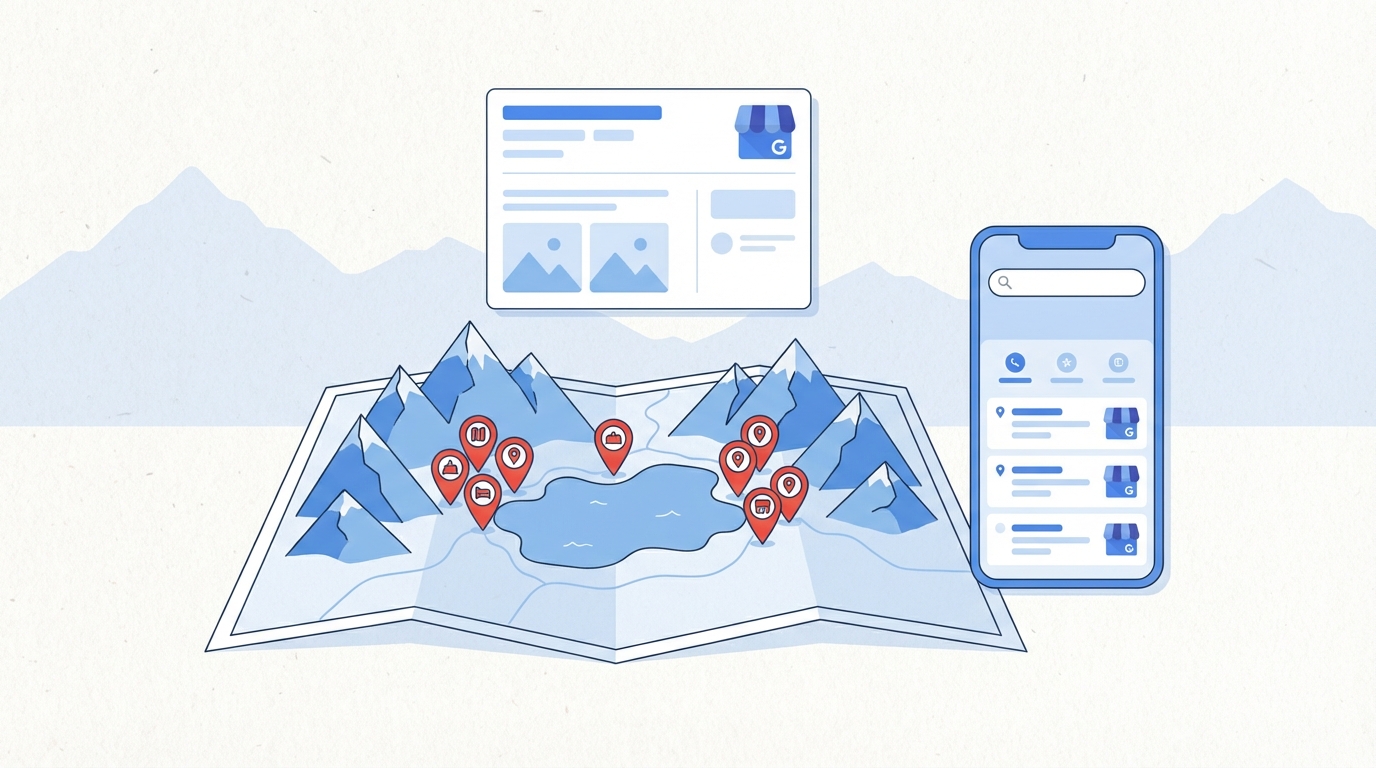
The local pack is the box that appears at the top of search results for queries with local intent. It shows three businesses with their Google Business Profile, rating, address and a Maps excerpt. For proximity searches, this pack captures between 30 and 45% of total clicks on the results page (BrightLocal study, 2024).
Google selects the three results based on three weighted criteria. Relevance measures the match between the query and your listing (categories, keywords in description, services listed). Distance calculates the proximity between the business and the user's location or the city mentioned in the query. Prominence evaluates the business's reputation by cross-referencing reviews, web citations, local press mentions and the authority of the associated website.
Distance is a factor you cannot control. Relevance and prominence, you can. Structured SEO work on these two axes makes the difference between a listing stuck at the bottom of the page and one that consistently appears in the local pack for your strategic queries.
A frequently overlooked feature: Google Posts. This functionality lets you publish news, offers or events directly on your GBP listing. Posts expire after seven days (except events), requiring regular publication. Their direct impact on ranking is debated, but they enrich the listing, increase click surface and signal to Google that the business is active.
Local Link Building: Building Your Site's Authority in the Region
Inbound links (backlinks) from local websites strengthen your site's authority in Google's eyes for geolocalised queries. A link from the Haute-Savoie CCI website, from a local media outlet like Le Dauphine Libere or Le Messager, or from a municipal website in the 74 department, carries more weight for your local SEO than a link from a generic directory.
Local link sources in the French Alps region fall into several categories. Institutional directories (CCI, CMA, intercommunal councils) generally accept free registrations. Professional associations and business clubs (BNI, entrepreneur networks, executives' clubs) often publish a member directory. Local partnerships (suppliers, clients, sponsored sports clubs) generate natural mentions.
The Haute-Savoie Fair in La Roche-sur-Foron, Annecy trade shows and French Tech in the Alps events create digital visibility opportunities. An exhibitor mentioned on the event website with a link to their site earns a relevant local backlink and a prominence signal.
Guest posting (writing contributed articles) on local blogs and media remains an accessible lever. Proposing an expert article to a local business media outlet or to the blog of a departmental professional association generates a quality link, exposure to a local audience and a thematic authority signal.
Tracking and Measurement: The Indicators That Matter
Running a local SEO strategy without measuring results is like navigating without a dashboard. Three data sources are essential.
Google Business Profile Insights shows the number of views on your listing, user actions (calls, direction requests, website clicks), the search queries that triggered your listing and comparisons with previous months. These data points reveal whether your listing is gaining visibility and whether that visibility translates into contacts.
Google Search Console filters performance by query and by page. By filtering queries containing your city name or "near me," you isolate your organic local SEO performance: impressions, clicks, average position and click-through rate. Declining impressions signal a ranking drop. Declining CTR with stable impressions indicates a meta description issue or increased competition in the results.
A local rank tracking tool (BrightLocal, Whitespark or Semrush's built-in tracker) measures your positioning for target queries from a simulated location. "Physiotherapist Annecy" searched from central Annecy does not yield the same results as from a neighbouring suburb. Precise geolocalised tracking reveals your zones of strength and weakness across the territory.
Monthly analysis of this data guides priorities. If your GBP views stagnate while organic positions improve, the problem lies with the listing itself (photos, reviews, categories). If local traffic increases but conversions stagnate, the problem is on the website (form, phone number, loading speed).
Frequently Asked Questions
How long does it take to appear in the Google local pack?
Initial visibility improvements typically appear between 4 and 12 weeks after optimising the Google Business Profile and correcting NAP citations. Breaking into the local pack for competitive queries (such as "plumber Annecy") often requires 3 to 6 months of combined work on the listing, reviews, content and links.
My business has no storefront open to the public. Can I still rank locally?
Yes. Google Business Profile offers a "service area" option for businesses that travel to clients (tradespeople, home-service professionals). You define your service area without displaying a physical address. Local visibility works, but the absence of an address slightly reduces your chances of appearing in the local pack against a competitor with a physical location.
Do reviews on other platforms (Yellow Pages, Facebook) count for local SEO?
Google primarily uses its own reviews for local ranking. Reviews on other platforms contribute indirectly by reinforcing your overall reputation and online presence consistency. Focus your efforts on Google reviews, but do not neglect other platforms for the trust they build with prospects who check them.
Should I create a separate page for each city where I operate?
Yes, provided each page offers unique, relevant content for the targeted city. A duplicated page with only the city name swapped will be ignored or penalised by Google. If you have no specific content to contribute for a particular city, group neighbouring localities by geographic zone rather than multiplying thin pages.
Does local SEO work for e-commerce businesses?
An e-commerce business based in the French Alps that offers local delivery or in-store pickup benefits from local SEO. For a purely national e-commerce operation, local SEO is not the priority lever, unless you want to strengthen brand credibility with an identifiable physical address.