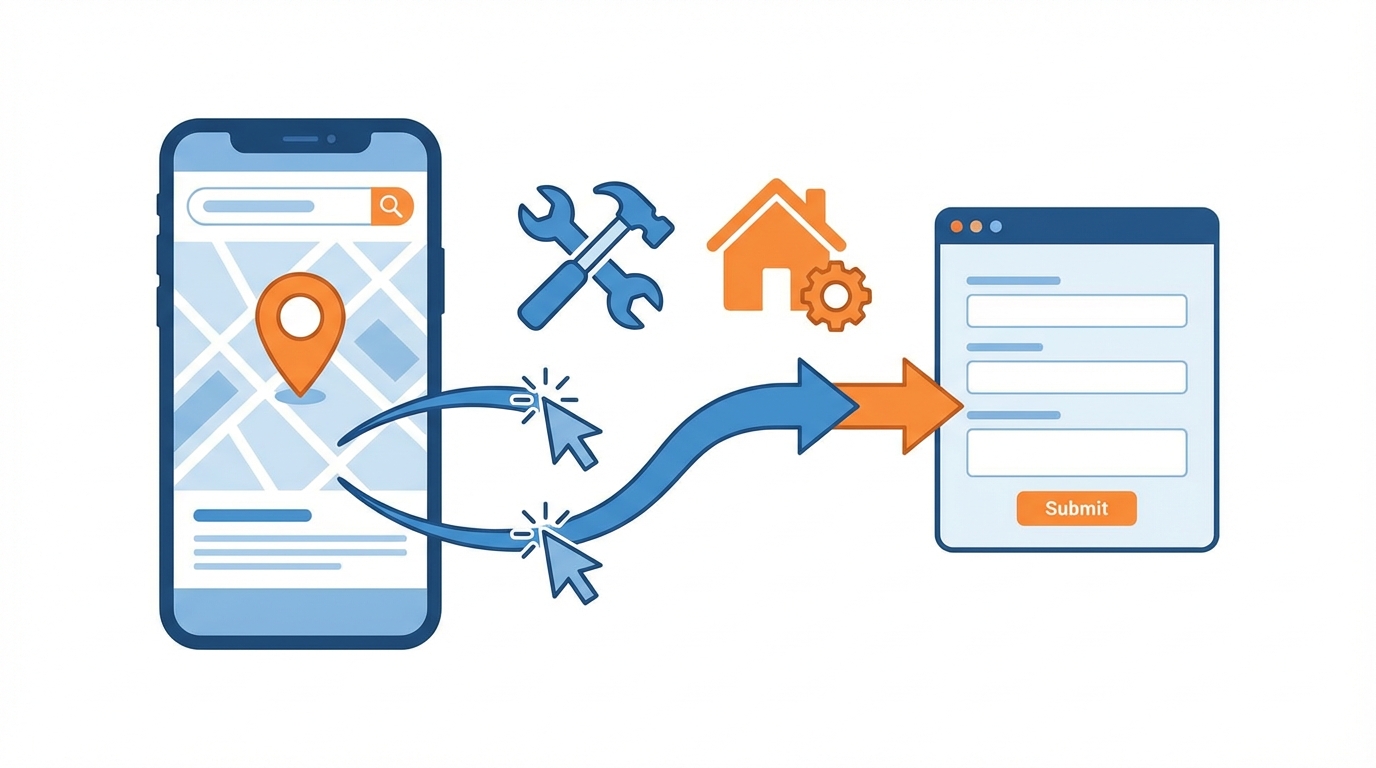


A homeowner with a burst pipe does not browse the Yellow Pages. They pull out their smartphone and type "emergency plumber" followed by their town name. According to Google (2024), 76% of local mobile searches lead to a visit or call within 24 hours. For a plumber, every position on the Google Ads results page translates into direct inbound calls. The problem is that cost per click in emergency plumbing ranges from $10 to $25 in most markets. Without structure or method, a $1,200 monthly budget evaporates in days without generating a single job.
This article details the concrete method for building a profitable Google Ads account when you are a plumber. No empty theory: structural choices, keyword strategies, budget decisions, and tracking setups you can apply from week one.
Why Google Ads is the priority channel for plumbing
Plumbing stands apart from other trades because of the nature of its demand. A large share of revenue comes from emergencies: leaks, clogged drains, water heater failures. These situations leave the prospect no time to compare five quotes. They call the first credible professional who appears in their search results.
Google Ads captures this intent at the exact moment it manifests. The prospect does not need convincing they have a problem. They already know. They need an immediate, local solution. This intent-driven mechanism makes Search fundamentally different from social media advertising, where you must first interrupt the user's scrolling.
Geographic targeting reinforces this efficiency. A plumber in the French Alps can restrict ad delivery to a 10 or 15-mile radius around their office. Every dollar invested reaches a prospect within their actual service area. Clicks from curious people 50 miles away disappear from the account.
According to WordStream (2024), the average Google Ads Search conversion rate for home services reaches 8 to 12% on well-structured accounts, compared to 4.4% across all industries. This differential illustrates the power of intent in emergency trade businesses.
Segment the account by intervention type
Profitability in a plumber's Google Ads account starts with structure. The classic mistake is lumping everything into a single campaign: emergency repairs, installations, maintenance. The result is predictable. Ads become generic. Quality Score drops. CPC climbs.
The structure that works relies on three distinct campaigns, each with its own budget and dedicated ad groups.
The first campaign covers emergency and repair work. It groups high-intent queries: water leak, drain unblocking, water heater failure, leak detection. This segment captures the hottest prospects. CPC runs high ($10 to $25 depending on market and competition), but conversion rates often exceed 10%. The average ticket for an emergency call ($250 to $600) justifies the investment.
The second campaign targets new installations: water heater installation, bathroom remodel, softener setup, sanitary connections. The decision cycle is longer. The prospect requests a quote, compares, reflects. CPC is generally lower ($5 to $12), and the average ticket significantly higher ($1,500 to $5,000+). Return per lead compensates for the lower close rate.
The third campaign addresses maintenance and servicing: water heater flushing, boiler service contracts, fixture replacement. A lower-volume segment but with strong retention. A customer who signs a maintenance contract returns every year.
This segmentation lets you adjust bids, daily budget, and ad messaging to the reality of each service type. An emergency message ("1-hour response, 7 days/week") has no place on a bathroom remodel ad.
Build an adapted keyword strategy
Keyword selection drives everything else. For a plumber, three query families coexist, each with different logic.
Emergency keywords form the account core. "Emergency plumber + city", "water leak + city", "plumber repair + city", "drain unclogging + city". These queries concentrate prospects ready to call within minutes. Recommended match type: phrase match or exact match to prevent irrelevant triggers.
Service keywords broaden the scope: "water heater installation + city", "plumber bathroom + city", "tankless heater replacement + city". Still commercial intent, but with a longer decision timeline. Phrase match with city modifiers captures variants without blowing up the scope.
Location modifiers are non-negotiable. Every keyword must include the city, metro area, or zip code. "Emergency plumber" alone triggers impressions nationwide. "Emergency plumber Denver" targets the prospect in your zone. Geographic targeting in campaign settings does not always suffice, because Google interprets zones broadly by default.
As for negative keywords, they protect the budget daily. A plumber account must exclude from the start: "jobs", "hiring", "training", "salary", "free", "how to DIY", "hourly rate plumber", "average cost", "tutorial". Without this negative list, a significant share of clicks comes from job seekers or DIY enthusiasts. These clicks cost $10 to $20 each and generate zero revenue.
Negative keyword management is an ongoing process. The search terms report should be analyzed weekly to spot irrelevant queries and add them to the exclusion list. This discipline is one of the main profitability levers, as explained in our Google Ads guide for tradespeople.
Essential ad extensions for plumbing
Ad extensions (or "assets" in current Google terminology) increase visible ad surface and add useful information for the prospect. Google indicates that adding extensions can raise CTR by 10 to 15% on average (Google Ads Help, 2024). For a plumber, certain extensions are not optional.
The call extension displays a clickable phone number directly in the ad. On mobile, the prospect calls with a single tap. Limit call display hours to actual availability to avoid missed calls.
The location extension shows the address and a link to Google Maps. It reinforces local credibility. Linking with Google Business Profile is required.
Callout extensions add short selling points: "Free estimate", "1-hour response", "24/7 service", "Licensed and insured". Four to six callouts cover the prospect's questions before the click.
Structured snippets specify services offered: "Emergency repair, Installation, Drain cleaning, Leak detection, Water heater service". This extension segments the offering without the prospect needing to visit the site.
The price extension filters prospects by showing reference pricing: "Drain unclogging from $89", "Water heater flush from $120". Bargain hunters looking for free service move on.
Set a realistic daily budget and bidding strategy
Daily budget depends on three factors: geographic area, number of active Google Ads competitors, and local search volume.
For a plumber serving a metro area of 30,000 to 80,000 residents, a daily budget of $30 to $60 provides visibility on emergency queries. That represents $900 to $1,800 per month. This amount may seem high, but relative to the average ticket of an emergency call, three to five jobs generated per month are enough to recoup the investment.
Budget distribution follows immediate profitability logic. The emergency/repair campaign receives 50 to 60% of total budget. Installation gets 25 to 30%. Maintenance absorbs the rest.
For bidding, Manual CPC suits plumbers just starting out or working with a small budget. It allows controlling each click and observing account behavior. Once the account records at least 30 conversions over 30 days, switching to Maximize Conversions or Target CPA takes over. The algorithm then has enough data to optimize in real time.
Watch out for the overbidding trap. A max CPC too low ($2 to $3) on emergency keywords excludes the ad from top positions. A max CPC too high ($30+) consumes the daily budget in four clicks. Aim for position 1 to 3 on emergencies, while being more conservative on installations.
Track every conversion to drive profitability
A Google Ads account without conversion tracking operates blind. For a plumber, three conversion types must be tracked.
Phone calls are the primary conversion. Google Ads offers a forwarding number to count calls longer than 60 seconds. A more reliable alternative uses a dedicated call tracking solution (CallRail, WhatConverts, or CallTrackingMetrics) that records source, duration, and call content.
Form submissions (quote requests, appointment bookings) are the second lead source. Tracking is configured via GA4 by setting up an event on the confirmation page.
Phone number clicks from the website complete the setup. This micro-conversion provides a supplementary contact volume indicator.
Implementing Consent Mode v2 is a technical prerequisite since March 2024. Without this implementation, conversion data reported in Google Ads is incomplete and automated bidding algorithms lose effectiveness.
The performance dashboard then boils down to four metrics: cost per call (CPA), conversion rate, cost per signed job, and ROAS. A plumber who knows each qualified call costs $35 and one in three converts to a $350 job can calculate net margin per dollar invested.
Realistic ROI: what plumbers can expect from Google Ads
Theoretical figures mean nothing without field validation. Here are order-of-magnitude figures observed on plumber accounts (aggregated data, 2024-2025).
A plumber serving a metro area of 50,000 residents with a monthly budget of $1,200 generates an average of 80 to 120 clicks per month on emergency campaigns. With a 10% conversion rate, that represents 8 to 12 qualified calls. If one in three calls results in a job billed at an average of $350, revenue generated reaches $930 to $1,400. Direct profitability does not always appear in the first month.
This calculation omits lifetime customer value. A satisfied customer calls back for an installation, recommends to neighbors, signs a maintenance contract. Progressive account optimization also improves ratios: ad refinement and data accumulation for automated bidding reduce CPA by 20 to 40% over six months.
On mature accounts (six-plus months of history, reliable tracking), average CPA settles between $25 and $45 per qualified call. For a $350 job with 50% gross margin, the break-even point sits around 3 calls per signed job.
Mistakes that tank profitability
Certain errors recur systematically on plumber Google Ads accounts. Spotting them early avoids weeks of wasted budget.
Using broad match without negative keywords triggers ads on parasitic queries. "Plumber" alone can display the ad on "plumber salary" or "plumber apprenticeship". Budget vanishes with no return.
Routing all clicks to the homepage instead of dedicated landing pages drops conversion rates. A prospect searching "drain unclogging Bonneville" should land on a page about drain unclogging, with a visible phone number.
Ignoring scheduling costs money. Emergency ads running at night when nobody answers generate $12 clicks with zero return. Adjusting schedules to actual business hours protects the budget.
Neglecting call tracking prevents distinguishing campaigns that produce revenue from those that consume budget for nothing.
Frequently asked questions
What is the minimum budget for Google Ads in plumbing?
A budget of $600 to $900 per month allows testing profitability in a 12 to 18-mile radius. Below that, click volume is too low to draw reliable conclusions. This amount covers roughly 50 to 80 monthly clicks on emergency keywords.
How long before a plumber's Google Ads account becomes profitable?
First calls arrive within the first week if structure and keywords are well chosen. Stable profitability typically arrives between months two and four, as conversion data accumulates, negative keywords are refined, and ads are optimized. The first six months are a learning phase for both the algorithm and the advertiser.
Does Google Ads replace SEO for a plumber?
The two channels address different timelines. Google Ads delivers immediate results and suits emergency queries. SEO builds lasting visibility on informational and local queries (Google Business listing, blog content). A plumber combining both captures emergencies via Ads and installation projects via organic ranking.
Should you manage your Google Ads account yourself or hire an agency?
Self-management is possible for a plumber willing to dedicate two to three hours per week: search term analysis, bid adjustments, adding negatives. The risk is letting the account run unsupervised, which generates waste. Hiring a specialized agency costs between $300 and $600 monthly in management fees, but secures ongoing optimization and conversion tracking.